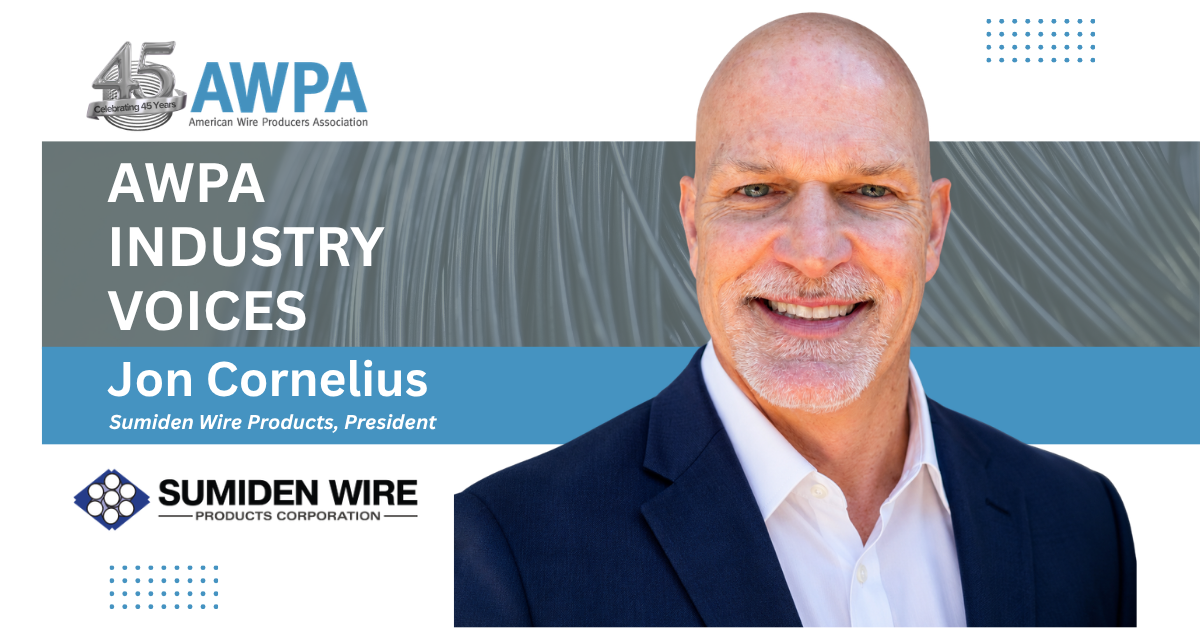
AWPA Industry Voices
Member Spotlight: Jon Cornelius, Sumiden Wire Products
At AWPA, we believe the future of the wire industry depends on the people leading it forward every day. Through AWPA Industry Voices, we’re highlighting the perspectives, experiences, and leadership shaping the North American wire industry.
This month’s spotlight features Jon Cornelius, President at Sumiden Wire Products. Having just completed his 30th year in the wire industry, Jon has experienced firsthand how every year brings its own unique set of challenges — and, as he puts it, this year is certainly no different.
Today, Jon sees one of the biggest issues facing U.S. wire producers as the imbalance between the cost and availability of domestic wire rod and the continued presence of lower-priced imported finished wire products.
The Section 232 steel tariffs have increased demand for U.S.-produced wire rod, which Jon notes was one of their intended goals. However, he says domestic wire rod supply has not meaningfully increased. As a result, many wire producers are dealing with restrictive allocations from U.S. mills while also having fewer competitively priced imported wire rod options available.
That leaves downstream wire producers in a difficult position. Raw-material costs have risen significantly, while imported finished wire products continue to enter the U.S. market using wire rod purchased at substantially lower global prices. According to Jon, domestic producers can be left with a difficult choice: surrender market share or reduce already-thin margins to remain competitive.
Jon has spent most of his career in the PC strand market, where competing with imports has been a recurring challenge. PC strand is one of the most active steel products under U.S. antidumping and countervailing duty laws, with more than 20 countries currently subject to some form of AD/CVD order. Yet, Jon notes, whenever one low-cost source is restricted, another frequently emerges.
He sees the global availability of low-cost steel wire rod as a major underlying factor, influenced in part by China’s enormous excess steelmaking capacity and the persistent global supply imbalance it creates.
Many of the same pressures exist on the stainless steel spring wire side of Sumiden Wire Products’ business, but the trade-remedy challenge is very different. Jon says the U.S. stainless steel wire industry has been gradually shrinking as lower-priced imported wire continues to take domestic market share.
Unlike PC strand, which is relatively concentrated in terms of product grades, tariff classifications, and channels of trade, stainless steel wire enters the United States in a much wider range of alloys, diameters, grades, finishes, and packaging configurations. That complexity makes defining the product and pursuing effective relief under the current AD/CVD framework much more difficult.
The practical result, Jon says, is that stainless steel wire production has continued to migrate outside the United States, leaving the domestic industry progressively smaller.
Section 232, in Jon’s view, is an understandable effort to strengthen the U.S. steel industry, but its current structure can create very different outcomes across the supply chain. U.S. steel mills benefit from stronger domestic demand and pricing, while downstream wire manufacturers still have to compete against imported finished products produced from significantly lower-cost raw materials.
“Finding the right balance between protecting domestic steel production and maintaining a competitive U.S. downstream manufacturing sector will continue to be one of the industry’s most important challenges.”
Those industry-wide pressures are also challenges Sumiden Wire Products is navigating directly. Like many U.S. wire producers, the company is working to maintain a reliable and competitively priced raw-material supply while continuing to compete against imported finished wire products.
Wire rod availability has become particularly important. Several domestic suppliers have placed limits or allocations on the amount of material available to the company, while the cost of sourcing additional wire rod from alternative domestic suppliers can make it difficult to remain competitive in some end markets.
The challenge is especially pronounced in PC strand, where imports remain very active. On the West Coast, Jon says the combination of import competition and limited access to competitively priced wire rod has forced Sumiden Wire Products to significantly reduce production at its Stockton, California facility.
The company faces a related but different challenge in stainless steel spring wire. Imported stainless wire continues to take U.S. market share, but because the product encompasses so many alloys, sizes, grades, finishes, and packaging forms, traditional trade remedies are much less straightforward. As the domestic stainless steel wire industry gradually shrinks, companies like Sumiden Wire Products are working to continue supporting U.S. production in a market where competitive pressure from imported finished products remains intense.
At the same time, the company continues to invest in productivity, new products, and differentiated technologies.
“Our goal is not simply to compete on price,” Jon said. “We want to provide products and capabilities that create real value for our customers and strengthen the case for manufacturing those products in the United States.”
Ultimately, Jon says the company is trying to balance three things: securing access to raw materials, remaining globally competitive, and continuing to invest in the people, equipment, and technologies that will allow the business to grow over the long term.
It’s in an environment like this that Jon sees particular value in AWPA.
AWPA provides an important forum for U.S. steel wire and wire product producers to come together around issues of common interest.
“Without AWPA, many of those relationships and conversations would have to develop independently, and I believe there would be significantly less collaboration across the industry.”
For Jon’s business specifically, AWPA also helps broaden his perspective beyond the markets he deals with every day. Sumiden Wire Products primarily consumes high-carbon and stainless steel wire rod, but through AWPA, Jon is able to interact with companies involved in low-carbon wire, specialty wire, and many other segments of the industry.
Those conversations give him a better understanding of the overall wire rod and wire markets. That broader perspective is especially valuable because challenges facing different segments of the wire industry are often related, even when the products themselves are very different. The pressures affecting PC strand, stainless steel spring wire, and other wire products frequently trace back to common issues involving raw-material availability, global overcapacity, import competition, and trade policy.
Jon also sees AWPA as an incubator for solutions — an environment where companies can identify common concerns, compare experiences, and determine whether there is an opportunity to work together.
Sometimes those efforts remain within the AWPA framework. Other times, AWPA provides the starting point for a smaller group of companies facing a particular issue to organize and pursue a solution independently.
“In that sense, AWPA helps make sure important issues affecting the U.S. wire industry do not go unnoticed.”
There is also a personal side to AWPA that Jon values greatly. Attending AWPA events gives him the opportunity to maintain relationships with people he has known throughout his career while continuing to meet new people entering the industry.
“The wire industry is filled with remarkably talented, genuine and resourceful people. I almost always leave an AWPA event with renewed energy and optimism about both the industry and the people who make it work.”
When Jon looks ahead to the next three to five years, he believes there are three things the steel wire industry needs to get right: trade policy, productivity, and people.
First, he believes the industry needs to remain actively engaged with policymakers so the downstream steel industry’s perspective is represented in future trade decisions. A healthy domestic steel industry is important, but Jon believes a healthy domestic manufacturing sector that converts steel into finished products is equally important. Trade policy, he says, needs to recognize the entire value chain.
He also sees a need for trade tools capable of addressing increasingly complex product categories. PC strand is relatively straightforward to define and track for trade purposes, while products such as stainless steel wire span numerous alloys, dimensions, grades, and end uses. If the goal is to encourage reshoring and preserve U.S. manufacturing capacity, Jon believes trade policy needs to be flexible enough to address those types of markets as well.
Second, manufacturers need to continue improving productivity and investing in technology. U.S. manufacturers operate in a high-cost environment, which means companies must continually find better ways to produce, automate, improve quality, and differentiate their products.
Third — and perhaps most importantly over the long term — Jon believes the industry needs to attract its next generation of people.
He frequently hears companies talk about how difficult it is to recruit and retain production employees, engineers, and other critical talent. In Jon’s view, the industry needs to do a better job explaining what a career in manufacturing has to offer.
As people increasingly wonder how artificial intelligence and automation will change the future of work, Jon points to something fundamental about the wire industry: steel wire remains part of the physical infrastructure of the world. Steel continues to be one of the most economical, durable, and abundant materials used in construction and manufacturing, and demand for steel wire products is not disappearing.
At the same time, many highly experienced people in the industry are approaching the later stages of their careers.
Jon sees an enormous opportunity for the next generation. Manufacturing can provide stable, rewarding, long-term careers for production employees, engineers, salespeople, and many other professionals.
He is also hopeful that the renewed focus on reshoring U.S. manufacturing and strengthening trade laws can help reverse some of the long-term erosion the industry has experienced in areas such as stainless steel wire production.
“If we can maintain a fair competitive environment, continue investing in productivity and successfully transfer knowledge to the next generation, I am very optimistic about the future of U.S. wire manufacturing.”
Jon’s own 30-year career is proof that a path into the wire industry can begin in unexpected ways.
“Like many men, some of the best decisions in my life can probably be traced back to a woman. My entry into the wire industry is one of them.”
When Jon graduated from college, his girlfriend — now his wife — was still attending school in Nashville. Moving back to the Nashville area seemed like a pretty good idea. It also meant he needed to find his first real job.
This was the pre-internet era of newspaper employment listings, recruiters, and lots of phone calls. After about three months of searching, a friend introduced Jon to a recruiter who had been hired to find someone for a new PC strand manufacturing plant being built just outside Nashville.
He interviewed for the position and, somewhat unexpectedly, his career in the wire industry began.
It was a true start-up operation. The production workforce was new, the equipment was older but new to everyone at the plant, and Jon was new. It was very much a sink-or-swim environment.
There were long hours, plenty of late-night calls, and more than a few setbacks. For those who remember them, many of those calls came over the old Nextel walkie-talkie phones. Jon says he can still hear the distinctive “beep-beep” chirp that seemed to go off at all hours of the day and night during those early years.
Looking back, he jokes that helping lead a manufacturing start-up is definitely a young person’s game.
But it was also an incredible learning experience. When everything is new, Jon says, you are forced to understand the equipment, the process, the people, and the business very quickly.
His first official title was Production Supervisor. Thirty years later, after a career that has taken him through a variety of roles within the organization, he now serves as President.
“I certainly did not envision that path when I walked into that first plant, but I am very grateful that a decision to move back to Nashville ultimately led me into this industry.”
After 30 years in the business, Jon has also come to appreciate just how much manufacturing careers are built through relationships and shared experience.
The wire industry is highly competitive, and the companies represented within AWPA compete with one another every day. But Jon says there is also a strong recognition that they share many of the same challenges — and that the overall health of the U.S. wire industry matters to everyone.
Some of the most valuable things Jon has learned during his career have come from conversations with suppliers, customers, competitors, and colleagues who were willing to share their experience.
That is one of the reasons he continues to value organizations like AWPA.
Jon also remains extremely optimistic about U.S. manufacturing.
“American manufacturers are remarkably innovative and adaptable. Give them access to competitive raw materials, a fair trading environment and good people, and they will find ways to compete.”
And after 30 years, that may be what Jon still enjoys most about the business.
“There is always another challenge to solve, another product to improve and another opportunity somewhere around the corner.”
Through AWPA Industry Voices, AWPA is proud to spotlight the members and companies helping strengthen and advance the wire industry across North America.
Interested in being featured in a future AWPA Industry Voices spotlight? Contact the AWPA team — we’d love to share your story.